

Pay Transparency and Uniformity at My Law Firm
In January 2023, all my law firm associates, partners and myself decided to disclose how much we get paid. Here is how and why pay transparency and uniformity started at YLaw.
Table of Contents
- 1 Pay Transparency Exists – Mostly Behind Closed Doors
- 2 Meet Our Law Team
- 3 The Bullet Proof Pay Confidentiality Clause
- 4 Human Nature Always Wins
- 5 Pay Uniformity at YLaw – Samples
- 6 What if as the Owner I Disclose My Pay and They Think I Make Too Much?
- 7 Are there Requirements for Salary Uniformity at the Law Firm?
- 8 What about Remote Workers? Do They Get Paid the Same?
- 9 What You Really Want to Hire a Candidate Who Wants More Pay? Do you Reject them?
- 10 Why Pay Equity and Salary Transparency Makes Sense
Pay Transparency Exists – Mostly Behind Closed Doors
A few months ago one of the lawyers at YLaw told me about an Excel pay spreadsheet that was being shared by associates at various big firms in town so they could compare pays and salaries.
I asked the associate to share the spreadsheet with me. I immediately studied it in detail with a beating heart, and at the end took a sigh of relief that my firm’s pay was fair compared to what I saw.
The Bullet Proof Pay Confidentiality Clause
I then remembered the ‘bullet proof’ confidentiality clauses I had put in our employment contracts threatening associates not to disclose their pay to each other otherwise they would face consequences. I however knew for a fact they all talked about their pay with each other. Regardless. Often.
Human Nature Always Wins
I realized how ridiculous I was being for trying to prevent people from talking about their pay in an attempt to reduce the risk of some feeling like they were underpaid or overpaid. A better way would have been to just pay everyone fairly and equally and to have nothing to hide because of it. Imagine the lightness I (and them) would feel.
These:
- pay Excel sheets,
- private meetings between law firm honchos to compare pays,
- associates having private talks about pays and negotiations,
- recruitment agencies sharing pay stats every year, etc,
- Anonymous online forums discussing lawyer pays,
happen regardless of whether I like it or not. Because it is our nature to be curious and find out. Then assess if we are being exploited or valued.
When I looked at the advantages and disadvantages of making my pay, our partners’ and associates’ pays fully transparent, the answer was a no brainer. Pay transparency was the way to go. I will explain that later below. But before that I wanted to share samples of how we did our pay transparency at YLaw.
Pay Uniformity at YLaw – Samples
I do not yet feel comfortable sharing the dollars and cents of our lawyers’ pays with the world. That is not the intent of salary transparency. The intent is to provide fairness within the workplace not outside of it. But I will share parts of our policy.
Here is a salary sample or our pay uniformity for our associates (you can Zoom in to see better):

Here is a split fee sample pay for our associates:
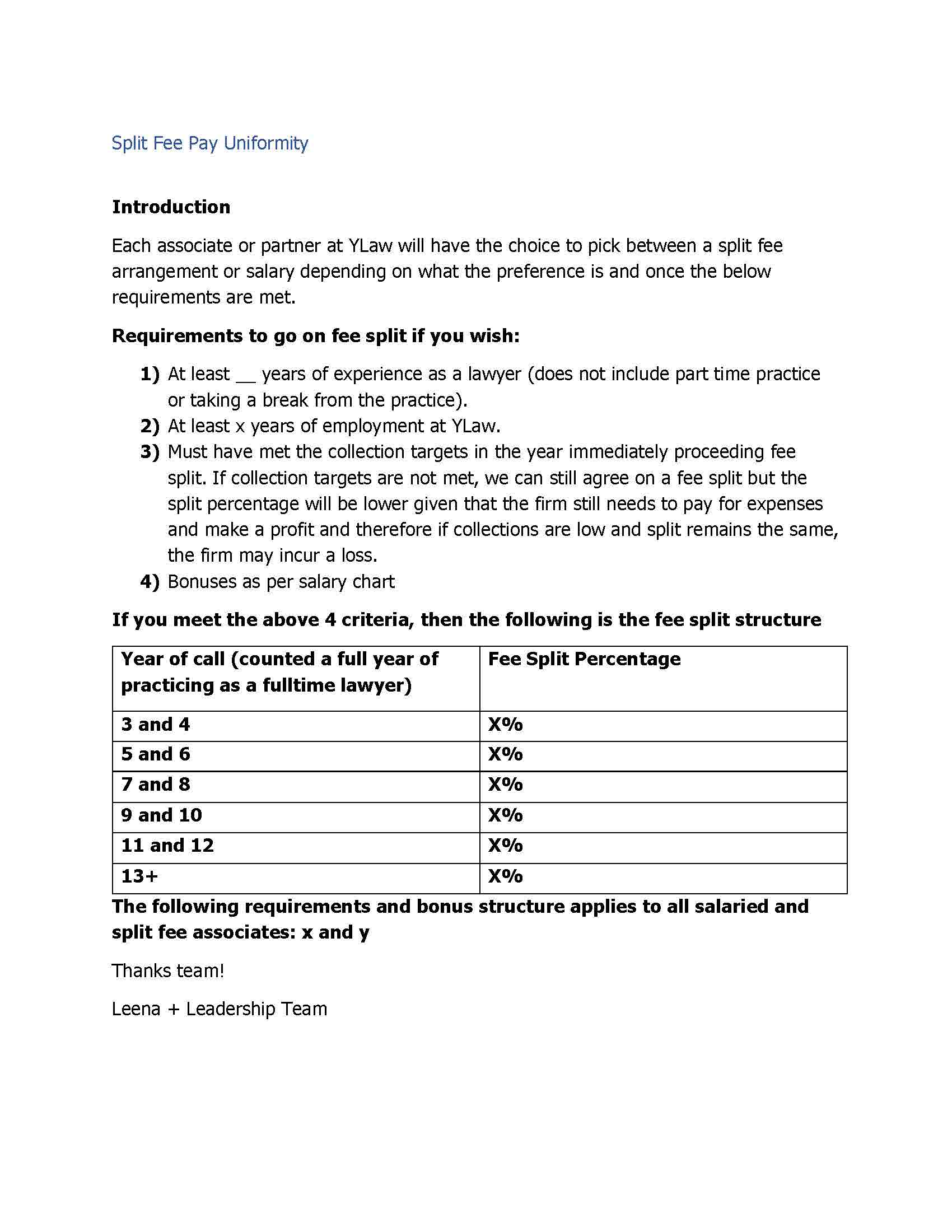
Partners and leaders’ pay charts are also disclosed. As for me, I am disclosing the dollar amount of how much I earn each year.
What if as the Owner I Disclose My Pay and They Think I Make Too Much?
Your associates probably already have a good idea about how much you make. They will simply do the rough math in their head based on the number of lawyers, and also look up online to see how much partners and owners make. They probably did this before they decided to apply for law school in the first place. I doubt it would come as a shock.
I remember when I was an associate and learned that my ex boss was making a crap ton of money, my first thought wasn’t that he was exploiting me. I simply thought he probably deserved to make that much because ‘that sh!t is hard”, he had so much experience, so many responsibilities and was damn good at what he did. What he made also encouraged me to grow my career and get to higher levels. To me, it wasn’t necessarily a negative thing.
Are there Requirements for Salary Uniformity at the Law Firm?
Yes, lawyers must meet their targets to be considered for this policy. It would not be fair to pay 2 associates the same rate when one does not meet his/her targets and the other one does. If an associate does not meet their targets, a different pay will be negotiated and disclosed to the rest of the team.
What about Remote Workers? Do They Get Paid the Same?
They will be paid slightly more because of the firm’s savings in not having to pay certain expenses. These includes their office rent, utilities, team outings and social events they won’t attend, etc.
Remote salaries will also be disclosed to all at YLaw.
What You Really Want to Hire a Candidate Who Wants More Pay? Do you Reject them?
Not necessarily. I would first ask why they want more pay. If they bring something very unique to the plate that would set them apart from the rest of the lawyers, I would determine whether it would be fair to pay them extra or whether the unique things they bring in would be considered under our bonus category. If I decide to pay extra based on extraordinary circumstances, I will disclose how much and why we are paying them extra. The point is that it would need to make sense. And be fair.
Why Pay Equity and Salary Transparency Makes Sense
Can you imagine a policy that would reduce or eliminate a lot of things that are wrong with the legal profession and we don’t seem to be able to resolve for decades? Pay uniformity would be one of those.
Negotiation Time
As an employer what I absolutely hate is the amount of time I have wasted in negotiating pay, pay reviews, etc. Not only has it been a waste of time for me go to back and forth playing the game, the whole thing has been stressful because it would create an us vs. them environment which ran against the core of YLaw’s culture which was about community, mutual giving and fairness.
Pay transparency would essentially eliminate any time wasted on negotiations as all incoming and current associates and partners would have to sign into our pay program and there would be no exceptions. This way, those who thought we were the right employer and the right place would sign up and know that they are being treated the same as everyone else, and those who thought they could do better or wouldn’t belong wouldn’t get started in the first place. This would lower our risk of turn over and all expectations would be set out and clear from the get-go.
Negotiation Power
Associates and students apply to YLaw coming from different work environment and backgrounds. Some are paid so little despite their experience and expertise that they do not ask for much when applying here and we could easily take advantage of that and offer them low pay.
On the other hand, we get applicants who spend days or weeks heavily negotiating very high pays that are unfair and a waste of everyone’s time. Pay uniformity and transparency tries to eliminate favourable treatments or paying someone more based on their negotiation skills rather than their expertise and experience.
Hold The Employer Accountable
Pay equity would hold me accountable to provide market competitive compensation and perhaps attract good candidates who are being short changed elsewhere.
Gender Pay Gaps
Pay equity means paying all of our lawyers, men or women, regardless of their sexual orientation, cultural, racial, etc, backgrounds exactly the same. Pay Transparency has been proven to reduce gender pay gaps and one of my life long career goals has been to eliminate gender pay gaps within the legal profession.
Employee Retention
Would you stay at a workplace that treated you fairly and equally or a workplace that tried to pay you as little as possible and make sure you keep it confidential so they don’t get exposed? ..yea, thought so.
Trust
If you don’t trust your employer, do you see yourself working at that work place long term? again, thought so. The most important element of employee retention for me has been to gain people’s trust and keep it.
It has been the only way I have been able to maintain our culture, be happy and work with happy people. Pay equity builds trust and moves the company’s culture in the right direction.
Written by Leena Yousefi – January 24, 2023.
This article is for information only and does not constitute legal advice. It does not create a lawyer–client relationship with YLaw or any of its lawyers. Laws and policies change, and information here may not reflect the most current legal developments. For full details, please contact us to obtain advice about your specific situation.