
Family Home on First Nation Land in BC: What You Need to Know
If your family home sits on First Nation land and you’re going through a separation, you are in a situation that most family lawyers, and most family law tools, are not built for.
The Fraser Valley and Lower Mainland have a significant number of properties located on First Nation lands under long-term leasehold arrangements or other unique land structures. These homes can look exactly like any other house on the street. But legally? They are a completely different animal.
Here is what you need to know if you are trying to protect your interest in one of them.
Table of Contents
- 1 Key Takeaways
- 2 Meet Our Family Law Team
- 3 Why First Nation Land Plays by Different Rules
- 4 Your Options for Protecting the Family Home in BC
- 5 What Happens When a CPL Is Available on First Nation Land
- 6 How Ownership Gets Identified on Reserve Land
- 7 If You Are Not Sure, Assume It Matters
- 8 Frequently Asked Questions
- 9 This Is Not a DIY Situation
Key Takeaways
- A home on First Nation land plays by different rules. Most BC family law tools are built for property registered through the Land Title and Survey Authority (LTSA), and these homes usually are not in that system.
- The land structure decides your options. It may be reserve land held by the Crown, Certificate of Possession land, or land under a First Nation’s own land code through the First Nations Land Management Act.
- Standard protections may not apply. A Land (Spouse Protection) Act entry or Certificate of Pending Litigation (CPL) registers against LTSA title, which may not exist here.
- A CPL is sometimes still possible, but harder. Registering through a First Nation often costs more, may need original documents, and takes longer, so timing matters.
- The Family Law Act still applies, but your lawyer has to use alternative strategies when LTSA-based tools are off the table.
Why First Nation Land Plays by Different Rules
Most real property in British Columbia is registered under the Land Title Act and is searchable through the Land Title and Survey Authority (LTSA). When a family lawyer looks up a family home, they can quickly find:
- Who the registered owner is
- Whether the property is held as joint tenants or tenants in common
- Any mortgages, liens, or covenants attached to the title
That information shapes how we value and divide family property.
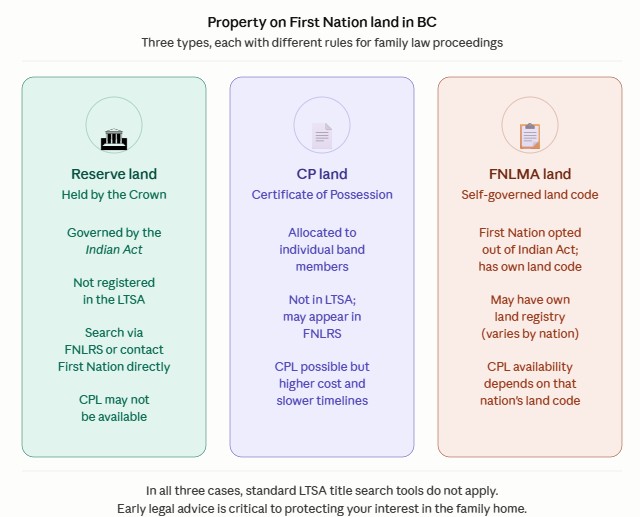
Property on First Nation land is not registered through the LTSA. Instead, it may fall under one of these structures:
- Reserve land held by the Crown for the use and benefit of a First Nation
- Certificate of Possession (CP) land allocated to individual band members
- First Nation-managed land under a land code adopted pursuant to the First Nations Land Management Act (FNLMA)
That distinction changes everything about how the property can be searched, protected, and addressed in family law proceedings.
Your Options for Protecting the Family Home in BC
Do you actually know whether your home is searchable in the LTSA, or are you assuming the usual protections will work? If your home is on First Nation land, the standard tools may simply not be available, and finding that out late can cost you the house.
In British Columbia, there are several ways to protect your interest in a family home during a separation:
- An entry under the Land (Spouse Protection) Act
- A Certificate of Pending Litigation (CPL)
- Preservation orders under the Family Law Act, the Law and Equity Act, and the Supreme Court Family Rules
The first two work by registering a charge against the title of the property through the LTSA. That registration prevents the home from being sold or transferred while your family law matter is underway.
Preservation orders are more commonly used for non-real property, like freezing bank accounts or preventing the dissipation of other assets.
Here is the problem. If your home is on First Nation land, it may not be searchable through the LTSA at all. And if it is not in the LTSA system, a standard Land (Spouse Protection) Act entry or CPL may not be available. Find out where you stand before you rely on the wrong protection.
What Happens When a CPL Is Available on First Nation Land
Every week you wait is another week the home could be sold or transferred out from under you. Is your interest actually protected right now? On First Nation land, registering protection takes longer, so the clock matters even more.
In some cases, it is still possible to register a CPL against a property on First Nation land, but the process is more complicated and more expensive.
A few things to know:
- Registration costs are higher. Filing a CPL through a First Nation often costs more than doing it through the LTSA.
- Original documents are usually required. Many First Nations require original documents to be physically sent to them, which adds delays.
- Speed matters. The longer you wait, the more time there is for the property to be dealt with before protections are in place.
This is exactly why getting legal advice early is so important. If you suspect your family home might be on First Nation land, do not wait until you are further into your separation to find out.
How Ownership Gets Identified on Reserve Land
Do you even know which land structure your home falls under? Reserve land, a Certificate of Possession, or a First Nation land code each unlock completely different tools, and guessing wrong wastes time you may not have.
Reserve land is administered under either the Indian Act or the First Nations Land Management Act. For a First Nation to move away from Indian Act administration, it must pass its own land code under the FAFNLMA.
When that happens, the First Nation typically has its own land registry and its own rules about what can be registered against land in that registry.
To get information about ownership, mortgages, or liens on reserve land, a family lawyer would need to use the First Nations Lands Registry System (FNLRS) or contact the First Nation directly. This is different from the standard LTSA title search that most people are familiar with.
Whether a CPL can be registered with a particular First Nation depends on:
- The specific terms of that First Nation’s land code
- Whether the land registry recognizes court-filed notices
- Whether the First Nation permits encumbrances arising from family law disputes
There is no single answer. Every First Nation has its own land governance structure, and that structure determines what tools are available to protect your interest.
If You Are Not Sure, Assume It Matters
Not sure whether your home is even on First Nation land? A lot of people do not know whether their property is on First Nation land until they are already in the middle of a family law dispute. If you are in the Fraser Valley or anywhere in the Lower Mainland, it is worth asking the question early.
A family lawyer experienced in property division can help you identify what type of land your home sits on, what protection mechanisms are available, and how to act quickly if you need them.
Frequently Asked Questions
Can I protect my interest in a family home on First Nation land in BC? Yes, in many cases you can, but the methods available depend on the type of land and the specific First Nation’s land governance structure. Options may include a Certificate of Pending Litigation, a preservation order, or other strategies developed with the help of a family lawyer.
What is the difference between the LTSA and the First Nations Lands Registry System? The Land Title and Survey Authority (LTSA) manages real property registered under BC’s Land Title Act. The First Nations Lands Registry System (FNLRS) is a federal registry for lands that the Indian Act administers. Property on reserve land does not appear in LTSA searches.
Is a Certificate of Pending Litigation available for First Nation land? Sometimes. It depends on whether the First Nation has its own land code and whether that land code allows for encumbrances arising from family law proceedings. The cost and timeline for registration are also different from the LTSA process.
What should I do if I think my family home is on First Nation land? Contact a family lawyer as soon as possible. The sooner you get advice, the more options you have. Delays can limit your ability to protect your interest in the property.
Does the Family Law Act still apply to property on First Nation land? The Family Law Act governs family property division in BC, but how you protect and transfer that property depends on how you hold the land. When standard LTSA-based tools are unavailable, family lawyers turn to alternative strategies.
This Is Not a DIY Situation
Family property on First Nation land is one of the most nuanced areas in BC family law. The rules are different, the registries are different, and the timelines for protecting your interest can be tighter than you expect.
If you are going through a separation and your home is in the Fraser Valley, Chilliwack, or anywhere else in the Lower Mainland where First Nation land is common, get advice now. Not later.
YLaw’s Chilliwack family lawyers are familiar with the specific land issues that come up in this region. We can help you understand your rights, identify your options, and move quickly when it counts.
About the Author: Kathryn Panton is a family lawyer at YLaw practising in Chilliwack and the Fraser Valley. She advises clients on property division, divorce, and family law matters with a focus on practical, effective solutions.
This article is for information only and does not constitute legal advice. It does not create a lawyer–client relationship with YLaw or any of its lawyers. Laws and policies change, and information here may not reflect the most current legal developments. For full details, please contact us to obtain advice about your specific situation.