

How to Value and Divide Farmland at Divorce
A significant number of our family law clients in the Fraser Valley, Surrey, Chilliwack and Langley are farmers or people who own farms and homes on farmland. We understand the complexities involved.
Farms are deeply valued and treasured family assets because they represent not only a place of residence but also the land where families have grown crops, raised animals, and built a life together.
The connection between people and farmland is often emotional, cultural, and rooted in years of shared labour. It is a very different type of connection from what we typically see with apartments or standard residential homes. Thus, knowing procedures for dividing farmland during a divorce becomes unique compared to other property types.
Table of Contents
Disputes over Farmland
Given the strong attachment of humans and farms, it is natural that in the context of divorce, disagreements about farmland can become heated. Spouses may dispute whether the property should be sold and, very commonly, how much the land is truly worth.
One spouse may believe the property has significant value, that it holds strong future rezoning potential, and that the home or structures on it add substantial worth. The other spouse, who may not feel the same attachment, may want to sell quickly or may not believe the land is as valuable as the other spouse suggests. This makes decisions to divide farmland at the time of divorce quite challenging.
These emotional and financial dynamics make farmland valuation one of the more complicated and contentious issues in family law, and the assistance of a skilled family lawyer is vital in making sure your rights are protected and mistakes are not made.
The Importance of an Accurate and Fair Market Value
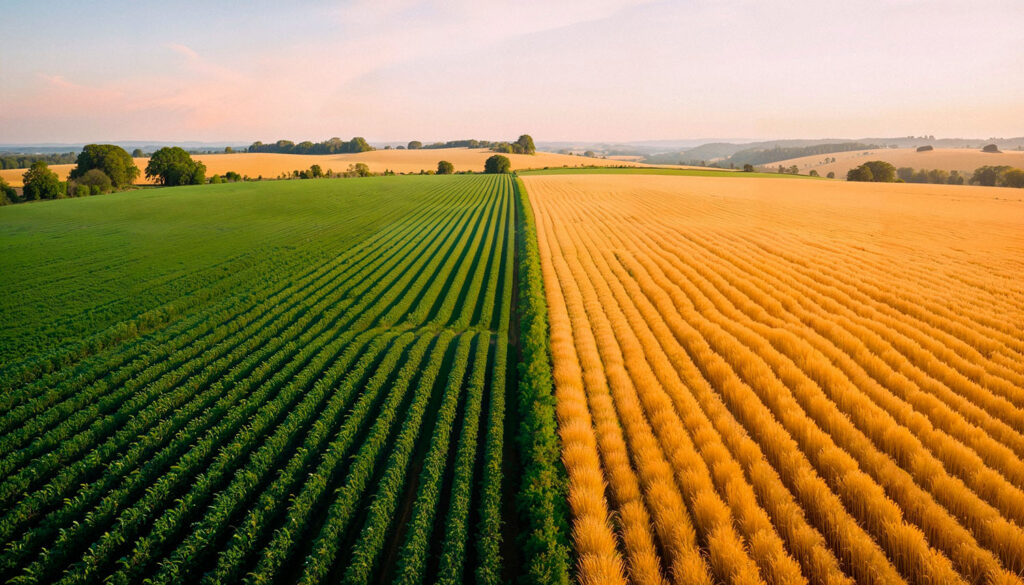
When dividing property, the general rule is that assets must be valued as of today’s date based on their current market value. Spouses are then required to divide those assets, usually on a 50/50 basis by default. This is especially important in determining how to accurately divide farmland at the time of divorce settlements.
For farmland, a proper valuation almost always requires a joint appraisal.
A realtor appraisal, a bank appraisal, or an appraisal obtained by only one spouse is unlikely to be accepted by the court.
The law requires that both spouses jointly retain the appraiser so that the resulting valuation is neutral and credible. As noted in our previous article, even a joint appraisal is not always final and can be challenged if it fails to account for important factors such as zoning restrictions, market speculation, or the unique characteristics of the property.
For more information on joint appraisals and how to challenge a valuation, click here.
Below are some of the most common questions clients ask when valuing agricultural land during separation.
Question: If I have 100 acres of farmland, surely my beautiful $500,000 barn adds value?
A: On a large farm, your barn may not add as much value as you might expect. The value often depends on what type of buyer is in the market. For large acreages, the buyer is frequently a land speculator rather than a farmer. Their focus is on long-term potential rather than current farming operations, so the barn may contribute little to the overall valuation. This will be reflected in any offer and in the appraisal itself.
Question: Can a barn add value to my property?
A: Yes. On a small 5-acre property, often referred to as a hobby farm or gentleman’s estate, the barn can add significant value. Buyers in this market are typically seeking a lifestyle rather than agricultural output. The barn becomes part of the rural experience they want to buy. Because smaller parcels cost less than extensive farmland, improvements like barns make up a more meaningful portion of the total value.
Question: Why is farmland so expensive in the Lower Mainland?
A: Farmland sells at extremely high prices because many buyers are betting on future rezoning. Some pay up to ten times the true agricultural value because they believe the land may be removed from the Agricultural Land Reserve at some point. Even though development is not permitted today, the possibility of future rezoning drives up demand and increases market value.
Question: How does this affect my taxes in a divorce settlement?
A: In a divorce, the Principal Residence Exemption usually applies only to the house plus one acre of land. If the farm is ten acres, the remaining nine acres are treated as business or investment property and are subject to capital gains tax.
Because capital gains tax can be very large, the appraiser must carefully divide the value between the tax-free home acre and the taxable farmland acres. This ensures a fair property division and prevents one spouse from being unfairly burdened with the tax implications.
If you are a farmer, own farmland or agricultural land, and are going through a separation, reach out to one of our very skilled divorce lawyers in the Fraser Valley and Vancouver to better understand your rights and obligations.
Fortunes can be involved, and mistakes in dividing farmland during a divorce can be extremely costly.
This article is for information only and does not constitute legal advice. It does not create a lawyer–client relationship with YLaw or any of its lawyers. Laws and policies change, and information here may not reflect the most current legal developments. For full details, please contact us to obtain advice about your specific situation.